

Life After 2025
A personal account of a pivotal moment in the development of AI tools and the moment when their capabilities begin to change the way we work
Mihael Giba, February 20, 2026
I have been following and using various forms of artificial intelligence since 2022. What began as curiosity evolved into an enjoyable, multi-year exploration of AI tools in both free and paid versions, from AI chatbots such as ChatGPT, Perplexity, and Claude, to text-to-image and image-to-image visual content generators like Midjourney, DALL-E, and Runway ML. Among my first AI projects was the installation of Stable Diffusion and the training of models with colleagues and students at the Academy of Applied Arts in Rijeka, where I work, which eventually gave way to the everyday use of chatbots for simple tasks such as translating emails, generating various texts, and even embedding a Google Workspace Apps Script for a ChatGPT Gmail assistant that suggests replies and appropriate tones for incoming messages. Today, all of that feels like a distant past, and the Stable Diffusion period at APURI during 2023 looks, both in terms of time and metaphorically, like a glance back at the Renaissance. Although it was advanced for its time, it is simply incomparable to what AI tools can do today.
Professionally, I work as a multimedia artist, while also developing web and interactive projects, educational and promotional video games, and Android applications. I have been programming in some form since university. I also work with IoT devices, which require writing code to adapt their behaviour within multimedia or artistic projects. Although in recent years I have used AI chatbots to assist with programming, which significantly accelerated the production of code and applications, I stopped writing code altogether a few weeks ago. The reason lies in AI.
Although Codex was released back in April 2025, and Claude Code in September 2025, I only found the time to engage with them seriously at the end of January. Installing Claude Code on 31 January 2026 was, for me, an absolute turning point. I did so primarily on the suggestion of my colleague Prof. Brajdić, who had already been testing it extensively on his own projects. Claude Code completed the first project at remarkable speed: within just three days, I had a finished online system that had processed large volumes of data, organised and formatted them for a database, and built a fully functional web application I was able to start using immediately. With my guidance, Claude Code needed approximately 30 hours to accomplish this. Without such a tool, it would never have crossed my mind to develop a web application, likely over several months, for a job that would only be carried out through it temporarily, for a maximum of two months, since the development alone would have taken longer than the actual use. With Claude Code, it was finished quickly, and will very likely end up as digital waste after use, because by the time it is needed again, technological progress will have turned it into a completely unnecessary relic.
Having installed Claude Code, I stopped writing code for my projects, but the real turning point came ten days later, on Monday, 16 February, just a few days after the release of the Claude Opus 4.6 model. That Monday, amid general chaos involving various obligations, travelling to Rijeka, beginning the installation of an artwork at the Museum of Contemporary Art in Zagreb, and cooking lunch that had to be ready for the children in the afternoon while my wife spent that same chaotic Monday out working on her own projects, I decided to give Claude Code the task of converting the XR portion of an artwork, which I normally present on a VR headset by running a real-time WebXR application in the browser in fullscreen kiosk mode, into an Android application for the VR headset. Claude Code was installed on my new laptop, on which I had not yet managed to install all the programmes and SDKs I normally use, and after a few brief questions, it got to work. Compiling the Android application required configuring a complete Windows development environment, including the installation of Node.js, the Java Development Kit, and Android SDK tools, as well as setting up system environment variables for the Gradle build system, all of which took Claude Code just over an hour, after which it delivered a fully functional XR Android application for my headset. When I asked how long it would have taken me, it estimated at least a full working day, and it was right; if anything, it was being optimistic.
Even before this project, I had given Claude Code access to my Raspberry Pi devices and servers, on which it can independently update code directly or by pushing to git. Through various tasks, I had gained a certain insight into its autonomy, exclusively through conversation, without any copy-pasting and without any need for my direct contact with the code it produces. Yet even that had not prepared me for what followed: for the first time in my life, a tool had completed a functional project on my behalf while I was entirely occupied with something else.
AI blogger and technology sector professional Jeff Seibert (2026) describes an almost identical experience. He notes that since December he has not written a single line of code; Claude writes it for him while he dictates in English. He adds that he can now deliver more software than ever before in his life, yet “a field I have dedicated my entire life to – will be automated.” I understand that sentence completely, from first-hand experience. AI entrepreneur Matt Shumer (2026) describes this pivotal moment in somewhat more dramatic terms, comparing it to the moment you realise the water is already up to your chest. Kyle Corbitt (2026) is more concrete and pragmatic, advising everyone to start seriously using paid versions of these tools and integrating them into real workflows, as being recognised as the person who uses AI best can secure professional relevance for months or even years.
The autonomy and speed of Claude Code and Opus 4.6 are astonishing. Like other users, I do not use Claude Code exclusively for coding but for for a wide range of tasks on my computer, as it executes them many times faster than a chatbot, and most often independently, without any need for human intervention. This was recognised within Anthropic itself: on 9 January, the @claudeai account on the platform X posted an open call inviting users to share what they were doing with it. Boris Cherny, head of the Claude Code team at Anthropic, has spoken on multiple occasions about how users are deploying Claude Code for entirely unexpected purposes, far beyond programming, recognising this as a growing trend. People have used Claude Code for everything from planning holidays, creating presentations, and clearing inboxes, to recovering wedding photos from damaged drives and tracking tomato growth, as well as managing smart ovens, filing taxes, designing knitting patterns, and analysing genomic data. It was precisely this unexpected “misuse‟ of a tool originally intended for developers that led Anthropic to develop Claude Cowork, a version that removes the barrier of the command-line interface and makes these capabilities accessible to everyone for everyday tasks. Cowork was built in just 10 days, with the code written by Claude Code itself, meaning that an AI tool essentially built itself into a new product.
The reason Claude Code’s execution speed is so superior to a browser-based chatbot is architectural: Claude Code operates as an agentic tool in the terminal with access to the entire file system. When given a task, it autonomously reads files, writes code, runs commands, fixes errors, and continues, all without waiting for the user to copy, paste, or manually confirm each step as one must in a browser. In a conversation with Claude Code about its speed and efficiency, it told me (Anthropic, 2026) that the entire workflow is dramatically more efficient because it eliminates the human as a bottleneck between steps. Eliminates the human, words that critics of AI would readily seize upon for sounding provocative, yet they do nothing more than describe the capabilities of this tool and model exactly as they are.
Seibert (2026), for instance, writes that the impact of AI is currently being experienced “completely unevenly” and that most developers will spend all of 2026 programming as they always have, except in certain pockets where an entirely new era has arrived. Shumer (2026) reminds us that tech workers went through this shift first precisely in order to warn others: they are not offering predictions but bearing witness to what has already happened in their own working lives. I never expected to live in a period in which tools could independently, or with minimal guidance, carry out extraordinarily complex tasks while I was doing something else entirely.
Yet while I speak of speed, efficiency, and reclaimed time, there is a dimension to this phenomenon that cannot be reduced to accelerated workflows and written code. Although this text was primarily written as a personal reflection on an experience that did not arise from an artistic process, I cannot avoid addressing the art I practice. In multimedia art, technology plays a central role, and AI is already deeply embedded in the tools and processes through which works and projects are created and presented. AI can enable artists to use systems they would otherwise lack the knowledge to operate, and for every creator, an entirely new parallel world opens up, one in which AI can serve as a studio full of employed assistants, apprentices, and interns. This conversation, in the context of AI, is only beginning, but it begins on ground that has long been prepared.
The crisis provoked by new technologies in art is a structural problem that predates AI by more than a century, and with it invariably come proclamations of the death of art itself. Photography was supposed to kill painting, film to kill theatre, television to kill cinema, and digital reproduction to destroy the aura of the original. Each time, the community was forced to redefine the boundary between the authorial act and the instrument, and each time art survived, transformed but alive. Duchamp’s readymades, Warhol’s industrial production model, net art of the 1990s, and the generative art of algorithmic systems were all points at which this pressure repeated itself. AI is not a discontinuity here but an acceleration of an already familiar process.
Given the pace at which these tools are developing, embracing, understanding, and beginning to use them is not a matter of enthusiasm but of adaptation. Within a few years, stagnation in this area will not be a neutral position but a form of maladjustment with real consequences, both professional and social. Every generational technological shift has produced a new kind of functional illiteracy among those who ignored it, and this one differs from its predecessors only in how fast it is moving and how little room it leaves for delayed decisions. This is not a matter of technological optimism but of simple calculation: those who understand what is happening and adapt will have more options than those who do not.
And finally, something for the attentive observer: at the bottom of the Claude interface, the following message currently appears: “Claude is AI and can make mistakes. Please double-check responses.” As an old Croatian proverb has it, he who works also errs, and both Claude and I can confirm this. But while I go home to rest each evening, Claude continues to work, to err, and to learn without pause. One day that message in the footer will disappear, and that will be one of the quieter yet clearer signs that we have crossed into a new chapter.
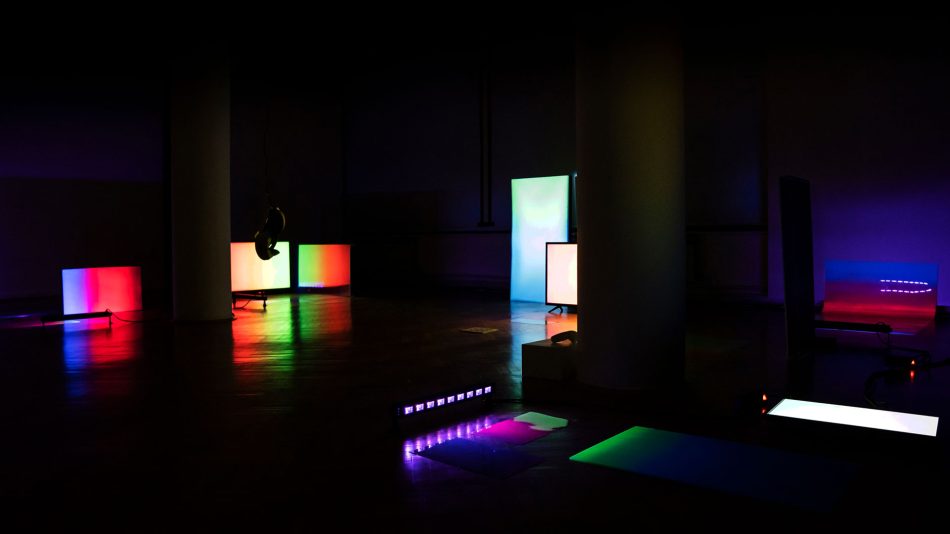
Figure 1
Installation view of the exhibition Presence. By Mihael Giba, 2025, VN Gallery, Zagreb, Croatia. Photograph by Sanja Bistričić Srića.
————————————————————
References
Anthropic. (February 18, 2026). Speed and efficiency of AI tools. [Generative AI conversation]. Claude. https://claude.ai/chat/5aa50a68-f412-42e6-a5da-819bd3f77112
Corbitt, K. (February 16, 2026). A pocket guide to surviving the robot apocalypse. corbt.com. https://corbt.com/posts/a-pocket-guide-to-surviving-the-robot-apocalypse
Seibert, J. (February 12, 2026). Thoughts on AI: AI is compressing timelines and changing the nature of work in ways that break our intuitions. jeffseibert.com. https://jeffseibert.com/posts/thoughts-on-ai/
Shumer, M. (February 9, 2026). Something big is happening. mattshumer.com. https://shumer.dev/something-big-is-happening